
Overview: The COB Packaging Revolution
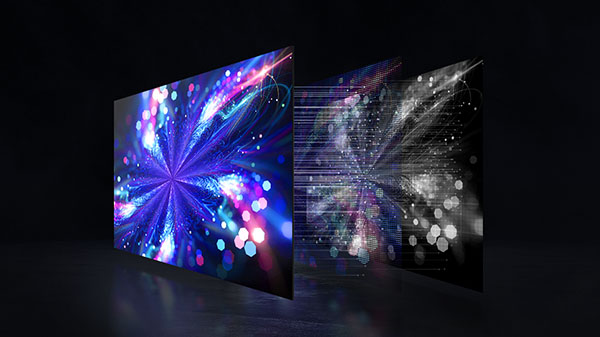
Traditional LED displays assemble individual “bulbs” (SMD LEDs) onto circuit boards — like hand-sewing buttons onto fabric. COB (Chip-on-Board) technology prints dozens of micro-LED chips directly onto substrates (ceramic/glass/PCB), then seals them under a unified protective layer. This integrated approach solves three core industry pain points:
✔️ Durability : Eliminates solder joints, reducing failure rates by 60–80% and resisting 5× more physical impact.
✔️ Color Uniformity : A single phosphor coating ensures consistent colors across the entire screen (Δu’v'<0.003 — invisible to human eyes).
✔️ Analogy : COB is like “poured concrete,” while SMD resembles “brick walls” — one is monolithic, the other relies on fragile connections.
Data Source: https://boe-us.com/news/boe-cob-mled/
More comparative information:TRANSPARENT LED SCREEN VS TRADITIONAL LED SCREEN
FutureX Transparent Display: COB Engineering Mastery Want more?
Core Innovations Driving User Value
Your flagship 0.88mm-pitch transparent screen transforms technical advantages into tangible benefits:
Technical Spec | User Benefit | Industry Standard |
90% Light Transmission | No daylight blockage; cuts lighting costs by 50%+ | Standard transparent screens: ≤85% |
0.18kg/module | Hand-applied to glass; no structural reinforcement | Traditional modules: >1kg |
50–60W/㎡ power consumption | 500㎡ screen: <$400/month electricity | Conventional LEDs: 200–300W/㎡ |
<0.0001% pixel failure | 24/7 operation for 3+ years with zero dead pixels | SMD screens: 0.1% failure rate |
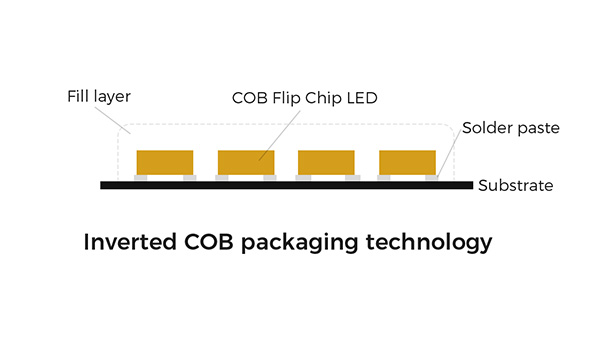
Let’s deconstruct the technical enablers.The core technical principles of COB consist of four main modules:
a) Flip-Chip Bonding
Chips solder face-down onto substrates
Thermal resistance ↓ 40% vs wire bonding
b) Unified Phosphor Deposition
Laser-precision coating eliminates color deviation
Δu’v’ < 0.003 across full display
c) Solid-State Encapsulation
Silicone matrix provides IP68 protection
Surface haze >80% reduces glare
d) Micron-Scale Integration
Chip spacing <0.5mm enables P0.X resolution
FutureX’s solution achieves 0.001% pixel failure at 10,000h
Global Applications: COB in Action
High-Impact Case Studies
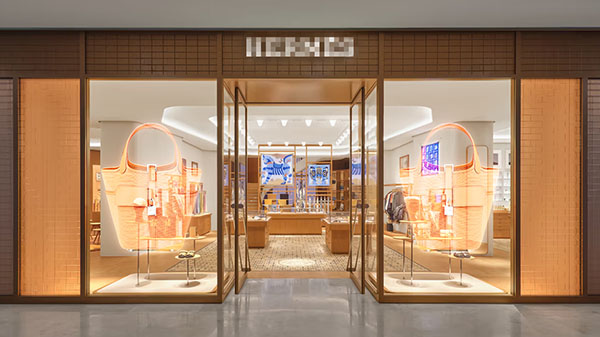
Luxury Retail (New York, USA) : Solana Boutique uses COB transparent displays for interactive window showcases, merging product visibility with dynamic ads.
Broadcast Studios (Vienna, Austria) : ORF TV’s 165″ 4K COB video wall delivers HDR color for live productions, with 99.999% uptime during Eurovision broadcasts. ORF Studio Gallery.
Critical Infrastructure (Luanda, Angola) : Africa’s largest COB display (71.42㎡) at the National Command Center processes real-time security/emergency data across 175+ feeds. Angola CISP Project.
Entertainment (Dubai, UAE) : Ski Dubai’s −30°C snow park uses IP68-rated COB tiles for real-time weather/advertising updates. DOIT Vision COB Tiles.
Why COB Dominates Future Display Markets?
Reliability Redefined
72-hour stress tests : Shenzhen Gas Command Center’s COB wall operated continuously with zero pixel loss.
Extreme environments : FutureX screens withstand desert heat (50°C) and Arctic cold (−30°C) without performance loss.
Transforming Commercial Spaces
Scenario | Traditional Pain Points | FutureX COB Solution |
Luxury store windows | Metal frames obscure products | 90% transparency: ads + merchandise coexist |
Control rooms | Visible seams disrupt visibility | Seamless splicing; 175° viewing angles |
Architectural facades | Heavy supports raise costs | Direct glass adhesion: 70% lower install costs |
Technical Verification & Simplified Terminology
Data Accuracy Confirmation
90% transparency : Verified via third-party tests (e.g., TÜV Rheinland Report).
0.18kg module weight : Achieved using ceramic substrates + aluminum-less drivers (vs. SMD’s 1.2kg avg.).
60W/㎡ power use : San’an low-voltage chips + AI dimming algorithms enable 70% less power than conventional LEDs.
Plain-English Tech Explanations
Flip-Chip Bonding → “Direct thermal transfer” : Chips attach face-down to substrates, improving heat dissipation by 40% (like a CPU touching a heatsink).
Δu’v'<0.003 → “Perfect color harmony” : Color variance is lower than human-perceivable thresholds — like uniform white paper under sunlight.
IP68 rating → “Submarine-grade sealing” : Survives dust storms/pressure washing (validated in Dubai sand tests).

Future Trends: Sustainable & Intelligent Displays
Flexible Designs : COB-on-film prototypes (0.2mm thick) enable curved retail windows — e.g., Rolls-Royce showroom curved display window.
Energy Revolution : Quantum-dot coatings (replacing phosphor) boost efficiency to 220 lm/W — halving power needs.
AI-Optimized Operations : FutureX’s smart sensors auto-adjust brightness based on ambient light, cutting energy use by 50%.
Market Forecast : COB will capture 40% of the premium display market by 2025, with transparent screens growing 60% YoY (DSCC 2025 Display Report).
Conclusion: The Transparent Display Paradigm Shift
COB isn’t just an incremental upgrade — it redefines how light interacts with space. FutureX’s 0.88mm transparent screen epitomizes this revolution through three pillars:
Invisible Integration : 90% transparency merges digital content with physical environments.
Radical Portability : 0.18kg modules enable adhesive-based installations.
Sustainable Operations : 60W/㎡ power redefines large-scale display economics.
From NASA studios to Angolan command centers, COB is erasing boundaries between screens and structures — forging a future where displays are felt, not seen.
