
HOW TO CHOOSE THE RIGHT TRANSPARENT LED SCREEN: ULTIMATE TECHNOLOGY COMPARISON
Transparent display technology has diversified rapidly, with solutions ranging from industrial LED grids to futuristic holographics. As a pioneer in COB-based transparent LEDs, we provide this definitive comparison to help you cut through the noise and match technology to your exact needs.
CRITICAL COMPARISON: 6 TRANSPARENT DISPLAY TECHNOLOGIES
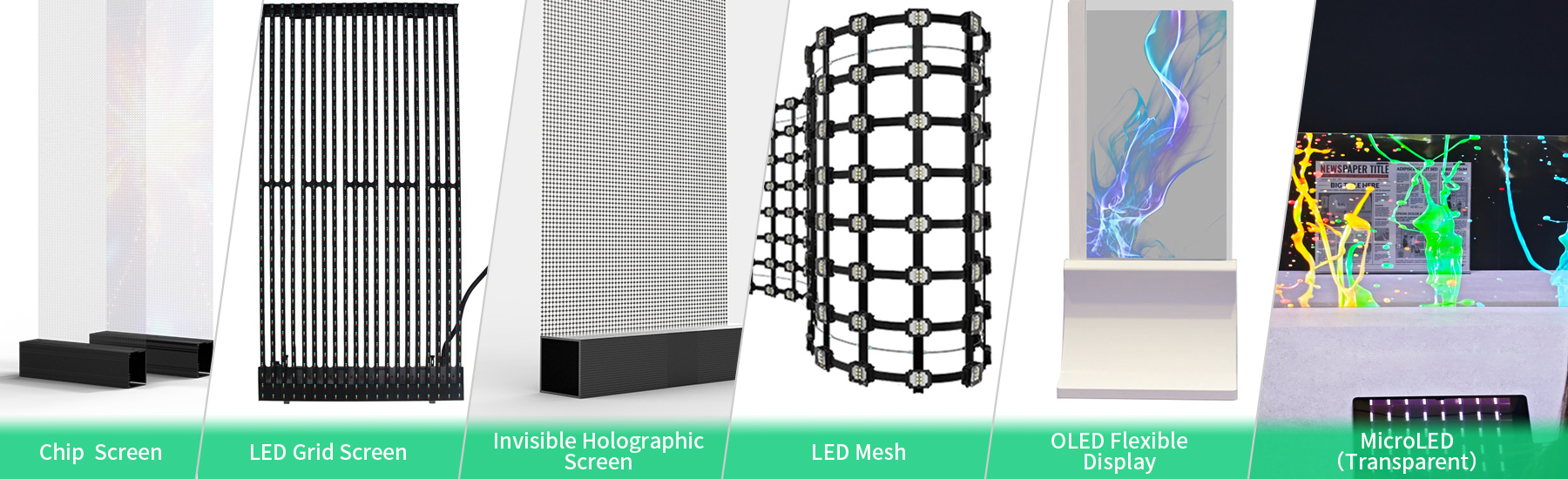
Parameter | COB Transparent LED (e.g., Our Solution) | LED Grid Screen (e.g., Nexnovo) | Holographic Film (e.g., Muxwave) | LED Mesh (e.g., Planar) | OLED (e.g., LG) | MicroLED |
Transparency | 90%+ | 40–70% | 80–85% | 50–65% | ~43% | 60–70% |
| Brightness (nits) | 500–1,500 | 5,000+ | 4,000 | 6,000–8,000 | 400 | 1,000–3,000 |
Thickness/Weight | 0.88mm / 0.18kg per module | 30–100mm / 15–25kg/m² | ~2mm / Film-based | 10–50mm / 3–8kg/m² | Panel-dependent | <1mm |
Installation | Reusable adhesive on glass | Metal Frame fixed | Adhesive film on glass | Cable suspension | Glass panel support | Rigid mount |
Outdoor Use | Limited (IP43 typical) | Yes (IP65+) | No | Yes (IP67) | No | Limited |
Key Strength | High transparency, low power, glass integration | High brightness, wind resistance | 3D effects, slim profile | Ultra-large installations | Self-emissive, High contrast | Future-proof |
Key Limitation | Max brightness <2,500 nits | Low transparency, bulky frames | Low durability, no outdoor use | Low resolution (large pitch) | Low brightness, short lifespan | Extreme cost |
| Ideal Application | Luxury retail, smart building lobbies | Outdoor billboards, stadiums | Indoor product showcases | Architectural facades | Indoor kiosks | R&D prototypes |
DEEP-DIVE ANALYSIS: MATCHING TECHNOLOGY TO YOUR SCENARIO
1. For High-Transparency Indoor Integration (e.g., Storefronts, Museums)
Choose COB Transparent LED when:
You need >85% transparency to preserve views/daylight.
Installation must be non-invasive (reusable adhesive on glass).
Energy efficiency is critical (50–60W/m² vs. OLED’s 100–150W/m²).
Avoid OLED despite its contrast: 43% transparency and 400-nit brightness fail in well-lit spaces.
2. For Outdoor/Large-Scale Displays (e.g., Billboards, Stadiums)
Prioritize LED Grid/Mesh Screens:
Grid screens handle 5,000+ nits and IP65 rating for harsh weather.
Mesh screens (Planar) enable curved building facades without heavy supports.
Reject Holographic/COB Screens: Neither withstands rain/UV exposure.
3. For Immersive Experiences (e.g., Showrooms, Exhibitions)
Opt for Holographic Film if:
3D effects are non-negotiable.
Ambient light is controlled (4000 nits struggles against direct sun).
Consider COB as Alternative: Lower visual “wow” but superior reliability (50,000 hrs vs. holographic’s 3–5 yr lifespan).
4. For Budget-Constrained Projects
LED Grid Screens offer the lowest upfront cost ($800–$1,500/m²) but sacrifice transparency and add structural costs.
COB Transparent LED balances TCO: Higher initial investment ($2,000–$3,500/m²) but 40% lower operating costs vs. grids.
5. Future-Proofing (MicroLED)
MicroLED promises self-emissive pixels (like OLED) with 100,000-hour lifespans, but:
Commercial reality: Pixel densities >P1.0 remain lab-grade ($50,000+/m²).
Short-term solution: COB delivers 90% of MicroLED’s benefits at 20% of the cost.
DECISION CHECKLIST: 4 CRITICAL QUESTIONS
Before selecting a technology, ask:
1.Where will it be installed?
Glass surface? → COB or Holographic.
Outdoor facade? → Grid or Mesh.
2.What’s the primary viewing distance?
<3 meters? → Prioritize fine pitch (COB P2.5–P6).
10 meters? → Mesh/Grid (P10–P30 acceptable).
3.How critical is energy/upkeep cost?
Low power + low maintenance → COB.
Capex-focused → Grid.
4.Do you need visual effects?
3D illusion → Holographic.
True transparency → COB.
THE VERDICT: WHEN OUR COB TRANSPARENT LED WINS
For 80% of indoor integrations—especially retail windows, corporate lobbies, and museums—our COB technology dominates with:
✅ 90% transparency (vs. 43–85% for alternatives).
✅ Zero structural modification (adhesive vs. frames).
✅ 50% lower defect rate vs. SMD/grid screens.
✅ 50–60W/m² power draw (vs. 150–800W for grids).
*Example: A luxury boutique using COB screens preserved window views while cutting energy bills by $3,200/year vs. grid screens.*
PRO TIP: VALIDATE CLAIMS
Test transparency: View samples behind glass at noon. 70% vs. 90% transmittance is visibly different.
Verify brightness: Demand nits measurements with content displayed (not white full-screen).
Inspect weight: Modules >0.5kg limit adhesive mounting options.
Final Advice: No “best” technology exists—only the best fit for your space, budget, and goals. By pairing this guide with real-world demos, you’ll transform transparent display from a buzzword into a strategic asset.
